About
The gap between what data and AI can do and what organisations get out of it
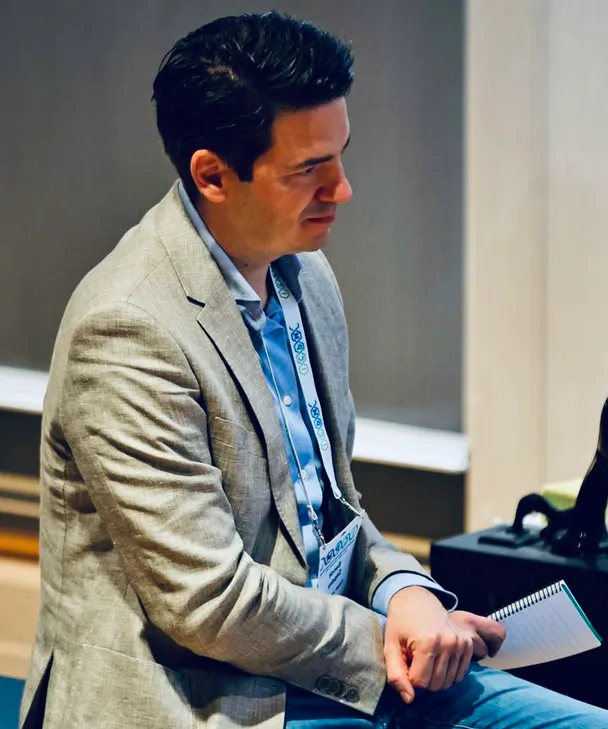
Organisations sit on a mountain of data, and today on a wave of AI, with far more potential than they put to use. That potential is only realised when you start not from the technology but from a real problem, and translate it into the right algorithms and the right place in your processes. That is what my research and my career are about: realising the potential of data and AI to move organisations and the people in them forward, from the strategic question down to the algorithm that delivers it.
Research and role
I am a full professor of Business Informatics at Hasselt University and co-lead the Business Informatics research group, a group of some twenty researchers. Together with Prof. dr. Yannick Bammens I founded the AI4Business research cluster, which brings together AI research within the Faculty of Business Economics: from internal lectures to joint projects and dialogue with companies. I am also part of theDigital Future Lab, the Hasselt University research centre that studies how we shape digital technology and AI with people at the centre.
My research sits at the intersection of data mining and process mining, in a business context: how do you learn from the digital traces that processes and decisions leave behind, and how do you turn that into sharper insight and better decisions? I've supervised more than twenty PhD researchers and am co-founder of the Event Data & Behavioral Analytics workshop.
Philosophy
AI, to me, is a means, not a goal. Almost every new technology today is announced as the holy grail. More is promised than delivered. But those who look past the hype do find the real value. I am convinced that technology can improve our work, our organisations, our society and our personal lives too, provided we start from the right point: the problem, not the tool.
At the same time, I don't want to minimise the difficulty: genuinely creating value from technology is hard, and it usually goes wrong in three places. First the problem itself. We convince ourselves too quickly that something is “the problem” and then solve the wrong one; the art is to reach the real, sharply defined question. Then the translation into concrete AI projects: seeing where AI actually adds something takes a broad knowledge of what technology can and cannot do; those who present AI as a magic wand usually hide precisely that lack of insight. And finally the execution, which turns on the right data of good quality and a model that truly learns what it needs to; even with a clear AI project, the question remains whether you reach the performance you need. On each of those three points, I help organisations move forward.
From research to practice
Through BIARU, the applied research unit I lead, I guide organisations through exactly those three challenges, from a sharply defined problem to a working prototype they can have integrated further. Alongside this, I give talks to organisations on what AI can and cannot mean for them.
A more personal closing note goes here: how research, teaching and family life relate to one another, what teaching means to me, and why this site exists. Benoît writes that text himself. A biography in thin, verified facts is no biography.